TL;DR: The Short Answer
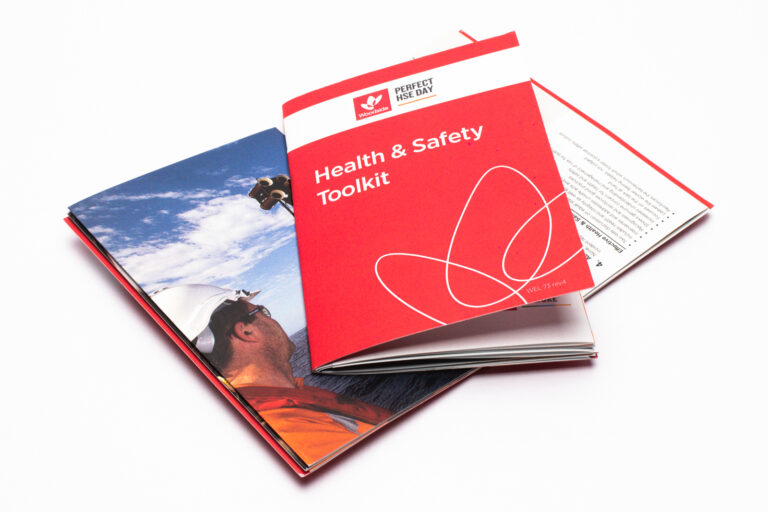
Once you’re past about eight pages of related content people need to hold onto, a bound booklet works harder than a folded brochure. Saddle-stitch suits 8 to 48 pages, perfect bound suits 40 pages and up, and wiro suits anything that needs to lie flat for daily use.
- A brochure folds. A booklet binds. The line is roughly the page count.
- Saddle-stitch, perfect bound and wiro each have a page-count sweet spot and a cost profile.
- Short runs and long runs are produced on different equipment, with different pricing curves, not the same job scaled up.
- Paper weight matters as much as binding. Too light and pages curl, too heavy and a saddle-stitched booklet won’t fold flat.
- A heavy or coated cover needs to be scored before folding, or it cracks along the spine.
If your content has outgrown a single sheet, you need a booklet. The short version: once you’re past about eight pages of related content that people need to hold onto, a bound booklet works harder than a folded brochure.
The two most common binding methods are saddle-stitch, stapled through the spine, and perfect bound, glued flat spine, and the right choice comes down to page count, budget, and how long the piece needs to survive.
Learn which binding suits your page count, how short runs and long runs are priced and produced, and the paper choices that prevent covers cracking and pages curling.
When Does a Brochure Become a Booklet?
The line is roughly the page count. A brochure folds; a booklet binds.
Up to 6 panels, folded
Brochure
A single sheet folded once or twice: a DL trifold or an A4 gatefold. Fast to produce, cheap to post, ideal for a single offer or a quick overview. Beyond six panels, folds get bulky and awkward to read.
8 pages and up, bound
Booklet
A catalogue with more products than a folded sheet can hold, a staff induction or training pack people refer back to over weeks, an event program with a schedule and speaker bios. A piece that needs to feel like a document, not a leaflet.
If your content is a single message and a single call to action, go with a brochure. If it’s a reference people keep, you’ve outgrown the sheet.
Saddle-Stitch vs Perfect Bound vs Wiro: Which Binding Suits Your Job?
Three binding methods cover almost every booklet job. Each has a page-count sweet spot and a cost profile.
| Binding | Page Range | Best For | Watch Out For |
|---|---|---|---|
| Saddle-stitch | 8 to 48 pages, up to 96 at EXBO | Event programs, product catalogues, course guides, short reports | Total pages must divide by four. Past roughly 48 pages, “creep” pushes inner pages out and needs trimming |
| Perfect bound | 40 pages and up | Thicker catalogues, annual reports, corporate profiles, anything identified by its spine | Under about 40 pages, there’s not enough thickness to glue reliably |
| Wiro | Any page count | Training manuals, workbooks, anything used hands-free | Less formal in appearance, not the right look for a customer-facing catalogue |
Saddle-Stitch (Stapled)
Pages are folded and stapled through the spine. This is the most common and cost-effective option for booklets between 8 and 48 pages. EXBO can even do 96 pages.
Past roughly 48 pages, thicker stapled booklets suffer “creep,” where inner pages stick out and need trimming, and the staple struggles to hold. It’s also less premium, since there’s no flat spine to print on.
EXBO can fix creep with our in-house designers. Our machine trims the pages sticking out to give a straight fore-edge, and the staples hold securely on our machine. We often produce a square spine so the book sits flat.
Perfect Bound (Glued Spine)
Pages are glued into a wrapped cover with a flat, printable spine. This is your choice for 40 pages and up.
It looks and feels like a professional publication, and the flat spine carries a title. The limit runs the other way: low page counts, under about 40, don’t have enough thickness to glue reliably.
Wiro (Wire or Coil Bound)
Pages are punched and bound with a metal or plastic coil. It’s durable, practical, and easy to add tabs or dividers, and it lies completely flat and folds back on itself, which makes it the right call for anything used hands-free.
Quick rule of thumb: under 48 pages and cost-conscious, saddle-stitch. Over 40 pages and premium, perfect bound. Needs to lie flat for daily use, wiro.
Short-Run vs Long-Run: Why 20 Copies and 2,000 Copies Are Different Jobs
This is where many first-time buyers get surprised. A 20-copy staff pack and a 2,000-copy customer catalogue aren’t the same job scaled up; they’re produced on different equipment for different economics.
Under a few hundred copies
Short run, digital press
No plate setup, so you pay very little to start printing, but the per-unit cost stays roughly flat as quantity rises. A 20-copy induction pack is affordable precisely because digital has no minimum setup penalty.
Into the thousands
Long run, offset press
Offset printing incurs a setup cost for plates, so low quantities are uneconomical, but once you’re printing thousands the per-unit cost drops sharply. A 2,000-copy catalogue is cheaper per booklet than a 200-copy one, even though the total is higher.
The practical takeaway: tell your printer the real quantity up front. It changes the press, the pricing curve, and the lead time. Ranges vary with page count, stock, and finish, so ask for a quote based on your actual spec rather than assuming per-unit cost scales in a straight line.
Paper Stock and Cover Weight: The Details That Stop Booklets Failing
The right stock is the difference between a booklet that reads well and one that curls, cracks, or feels cheap.
Weight by role, in gsm
Text-heavy inner pages
100 to 130gsm. Holds ink cleanly without ghosting.
Image-heavy catalogue pages
130 to 170gsm. Gives weight and colour depth.
Covers
250 to 350gsm. Protects the pages and feels substantial.
Too light, and pages feel flimsy and curl. Too heavy, and a saddle-stitched booklet won’t fold flat.
The saddle-stitch fold trap: heavy or coated cover stock cracks along the fold if it isn’t scored first. On a stapled booklet, always score the cover crease before folding, especially on darker or laminated finishes where a cracked white line shows badly. This is a finishing step, not an afterthought, and getting it wrong ruins an otherwise good print run.
For a full breakdown of scoring, laminating, and binding options, see our print finishing page.
Making the Right Call for Your Project
Match the format to how the product will be used.
| Use Case | Pages | Recommended Binding and Stock |
|---|---|---|
| Event program, one-time use | 16 to 32 | Saddle-stitch on a mid-weight stock |
| Customer catalogue, shelf presence | 48+ | Perfect bound with a laminated cover |
| Staff training manual, used daily | Any | Wiro bound with tabbed dividers |
| Short-run induction pack | 20 to 100 copies | Digital saddle-stitch, no setup penalty |
Get the binding and stock right at the quote stage and the rest will follow.
EXBO Is Ready to Print Your Booklet
Choosing the format is the hard part; production brings it all together. With EXBO, every stage, from print to binding to finishing, is handled in-house, so there’s no quality drift between suppliers and no coordination gaps on your deadline.
Bring us your page count and quantity for a spec-accurate quote, or review the print finishing options if you’re weighing binding and cover choices.
Still deciding whether a booklet is the right step up? Compare it against our guidance on brochures and flyers first.
Start Your Booklet
Send us your page count and quantity and we’ll recommend the binding, stock and press that fits the job, not just the look you’re after.
EXBO | Supply Nation Certified | WALGA Registered | ISO 9001 Accredited | Perth, Western Australia

Contact
Get In Touch

Top Products